Overview
TeleOp-BC studies behavioral cloning for a simulated box-pushing task. Demonstrations can be collected with a keyboard or MediaPipe hand tracking, and a learned policy then controls the same environment autonomously.
Human teleoperation
Implementation
The MuJoCo/Gymnasium environment uses a one-dimensional slider and a randomized target. Observations contain block position, block velocity, and relative distance to the target. The policy predicts a normalized force, scaled to a maximum magnitude of 10 N.
The PyTorch policy is a 3 → 64 → 64 → 1 multilayer perceptron with a tanh output. Training and rollout use the same saved observation-normalization statistics. Evaluation compares force trajectories and total mechanical work per episode.
Results
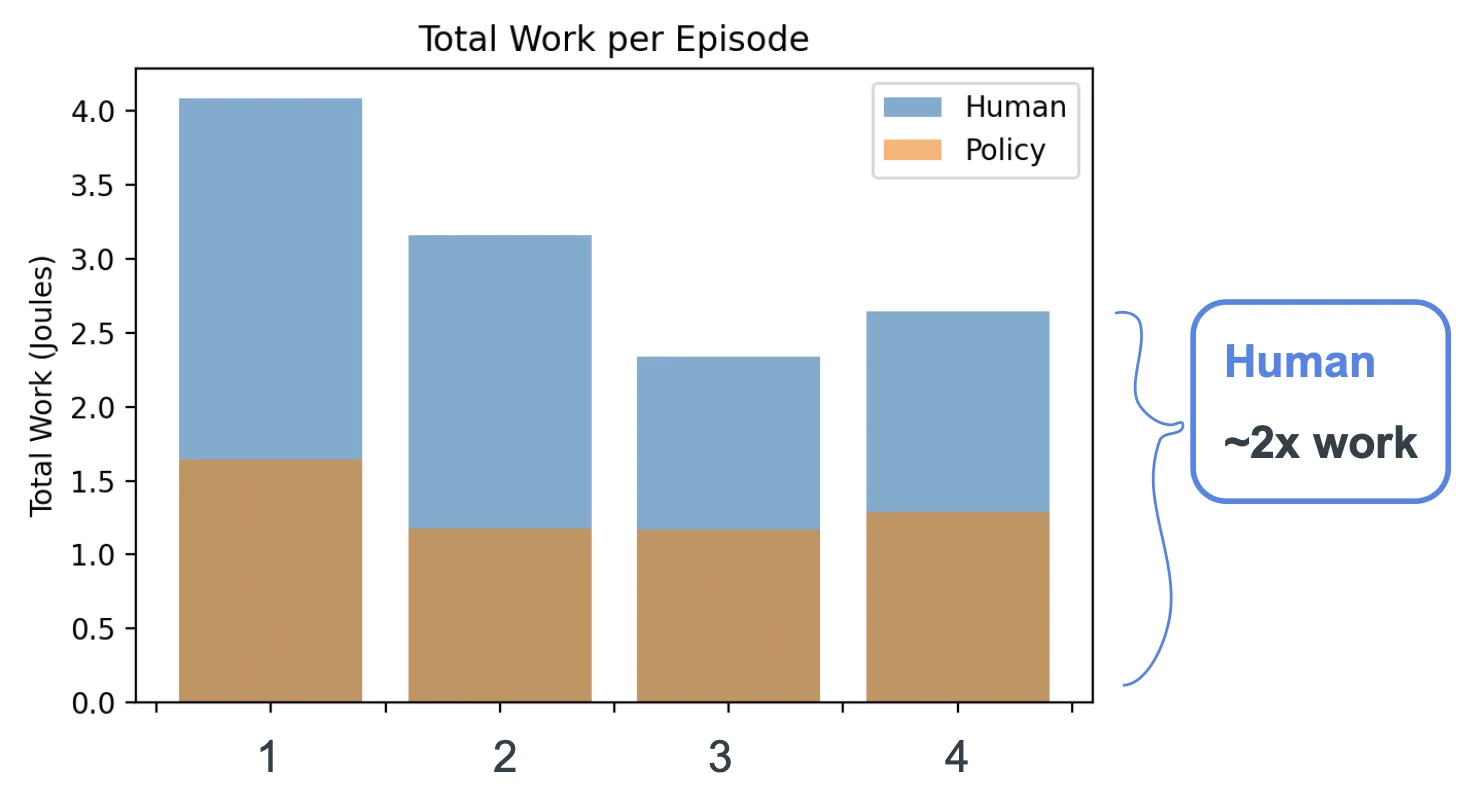
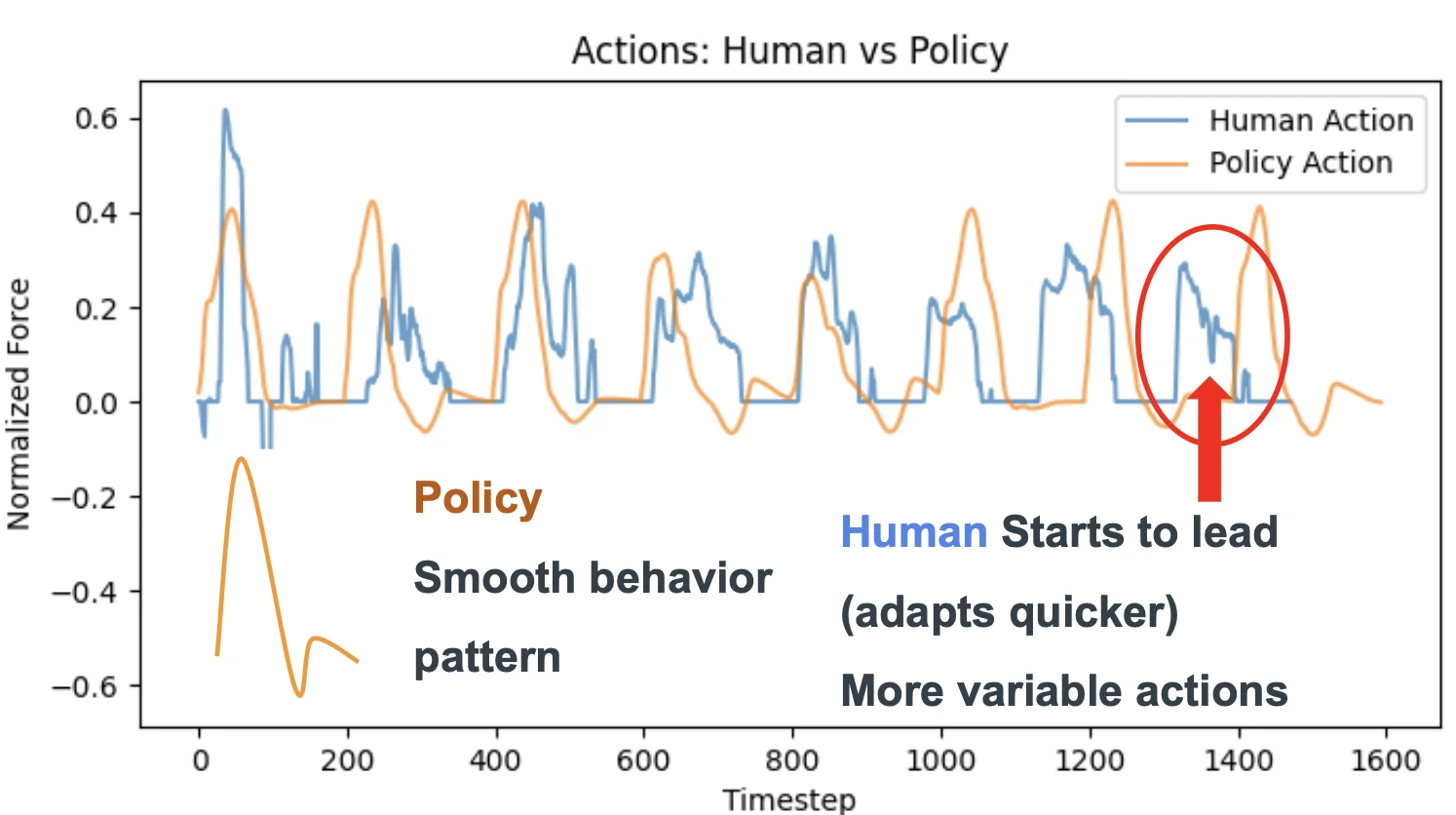
The repository includes four plotted evaluation episodes. In those examples, human teleoperation used roughly twice the mechanical work of the learned policy. The force traces show a smoother learned control pattern alongside more reactive human corrections.
Scope
The task is one-dimensional and simulation-only. Noisy demonstrations and the trade-off between smooth actions and rapid correction are important limitations. The project provided an earlier testbed for the teleoperation-to-learning workflow later used with Rotom.